
What Is Illegal in Bali for Tourists? 10 Rules & Laws to Know

What Is Illegal in Bali for Tourists? 10 Rules & Laws to Know


What is illegal in Bali for tourists? Although Bali is known as a welcoming destination for travelers, every visitor is still expected to follow Indonesian laws and local rules during their stay.

Some rules relate directly to the law, such as drug, immigration, and traffic regulations. Others are related to local customs and etiquette, especially when visiting temples and sacred places.

So, what should tourists know before visiting Bali? Here are some important rules to keep in mind.


What Is Illegal in Bali for Tourists?

Not everything considered disrespectful in Bali is necessarily illegal. It is important to understand the difference between laws, administrative requirements, and local etiquette.

1. Do Not Use or Possess Illegal Drugs

Indonesia has strict laws prohibiting the use, possession, distribution, and trafficking of illegal drugs. Drug-related offenses can carry serious legal consequences.

Tourists should not use or carry illegal narcotics while visiting Bali.

2. Do Not Work Without the Proper Permission

Tourists cannot simply work in Bali while visiting on a tourist visa. Working in Indonesia requires the appropriate visa and work authorization.

This applies to paid work, professional activities, and other forms of employment that require official permission.

3. Follow Traffic Regulations

Tourists who drive in Bali must follow Indonesian traffic regulations. This includes having the required driving documents and following road safety rules.

If you rent a motorcycle or car, make sure you meet the legal requirements before driving.

4. Follow Immigration Rules

Foreign tourists must comply with Indonesian immigration regulations throughout their stay.

Check your visa conditions, permitted length of stay, and other requirements before traveling. Overstaying or violating immigration conditions can lead to administrative or legal consequences.

5. Pay the Bali Tourist Levy

Foreign tourists visiting Bali are required to pay the Bali Tourist Levy. The fee supports efforts related to Balinese culture, nature, and sustainable tourism.

Check the latest payment information before your trip, as administrative procedures can change.

6. Follow the Rules When Visiting Temples

Temples are important religious spaces in Bali, so visitors should follow the rules provided at each location.

Some temples may have specific requirements regarding clothing, access, photography, or areas that tourists cannot enter. Always follow signs and instructions from temple staff or local authorities.

7. Do Not Step on Canang Sari

Canang sari are daily offerings placed by Balinese Hindus in various places. Visitors should avoid stepping on or disturbing them.

If you accidentally step on one, move away respectfully and avoid disturbing the offering further.

8. Respect Religious Ceremonies and Processions

Religious ceremonies and processions are an important part of daily life in Bali. Visitors should avoid blocking processions, walking through ceremonies, or behaving disruptively while religious activities are taking place.

When taking photos, keep a respectful distance and follow local instructions.

9. Dress Respectfully at Sacred Places

Visitors should wear appropriate clothing when entering temples and other sacred areas. Some locations may require visitors to cover their shoulders and knees or wear a sarong.

Following these requirements is a simple way to show respect for Balinese religious traditions.

10. Understand the Rules During Nyepi

Nyepi, or the Balinese Day of Silence, is observed throughout Bali according to the Balinese Hindu calendar.

During Nyepi, there are restrictions on activities such as travel, entertainment, and outdoor activities.

Tourists should remain at their accommodation and follow the rules communicated by local authorities and hotel staff.

 

What Is Illegal in Bali for Tourists – traveler raising both hands with a Bali beach and temple in the background.


Understanding the Difference Between Laws and Local Etiquette

Understanding the difference between legal requirements and local etiquette can help tourists know how to behave appropriately in Bali.
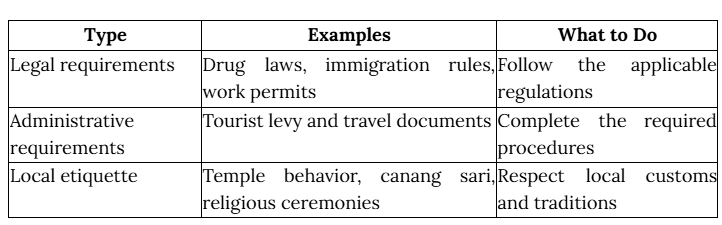
the Difference Between Laws and Local Etiquette


Local etiquette is closely connected to how visitors interact with Balinese communities. Actions such as sitting, climbing, or posing on a pelinggih can be considered disrespectful.

Avoid behavior that may show a lack of tolerance or respect toward religious spaces and local traditions.


See Also: How to Get To Nusa Penida from Bali


Tips Before Traveling to Bali

Before your trip, check your visa and travel documents. If you plan to drive, make sure you have the required documents.

Bring suitable clothing for temple visits and check the Nyepi schedule. During your stay, respect sacred places, religious offerings, and traditional ceremonies.

If you are unsure about a rule, ask temple staff, a local guide, or your accommodation. Understanding laws, administrative requirements, and local etiquette can help you enjoy Bali while respecting its culture and communities.(*)


Frequently Asked Questions

What is illegal for tourists in Bali?

Tourists must follow Indonesian laws, including strict regulations on illegal drugs, immigration, employment, and driving. Visitors should also follow local rules when visiting temples and sacred places.

Can tourists use drugs in Bali?

No. The use, possession, distribution, and trafficking of illegal drugs are prohibited under Indonesian law. Drug-related offenses can carry serious legal consequences.

What should tourists avoid doing in Bali?

Tourists should avoid using illegal drugs, working without the required permission, violating immigration or traffic rules, and disrespecting religious places or ceremonies. Following local customs is also important when visiting Bali.



How to Get to Nusa Penida from Bali: My Personal Travel Guide

How to Get to Nusa Penida from Bali: My Personal Travel Guide

If you’re wondering how to get to Nusa Penida from Bali, I’m sharing this guide based on my own trips, some research, and the experiences of friends who travel there regularly. Basically, you have four main departure points: Sanur Port and Serangan Port in Denpasar, Kusamba Port in Klungkung, and Padang Bai Port in Karangasem. So, which one should you choose? It really depends on where you’re staying in Bali, how you like to travel, and—most importantly—how well your stomach handles a bumpy boat ride.

1. How to Get to Nusa Penida from Bali via Sanur or Serangan

For most travelers, Sanur to Nusa Penida is probably the most familiar route. There are plenty of fast boats departing from Sanur, and if you book a Nusa Penida trip through a travel agent, there’s a good chance you’ll leave from either Sanur or Serangan.

Personally, I’d choose these routes if you enjoy a little adventure and don’t get seasick easily. The sea can get rough, so be prepared for a bumpy ride when the waves pick up.

A ferry to Nusa Penida from Sanur—or, more accurately, a fast boat—is also convenient if you’re staying around southern Bali. Fast boats departing from Sanur or Serangan commonly arrive around Banjar Nyuh in Nusa Penida.

Two travelers enjoying Nusa Penida while sharing their experience on how to get to Nusa Penida from Bali.

2. Kusamba Port: My Pick for Independent Travelers

If you’re traveling independently and you’re not a big fan of rough sea crossings, Kusamba Port is another option worth considering.

This is actually the route I often use myself. Two fast boat operators I’m familiar with are The Angkal and Gangga Express. From Kusamba, you can take a fast boat to Sampalan Port, on the northern side of Nusa Penida.

For me, Kusamba is a great choice when I want a simple, independent trip without joining a tour package. Just remember that boat schedules and ticket prices can change, so always check with the operator before you go.

3. Padang Bai: Take a Fast Boat or Bring Your Own Vehicle

Padang Bai Port gives you another interesting way to reach Nusa Penida.

You can take a fast boat, but there’s also a larger public ferry option. This is especially useful if you want to bring your own motorbike or car from Bali to Nusa Penida.

Of course, there’s a trade-off: the larger ferry is slower than a fast boat. But if having your own vehicle on the island matters more than getting there quickly, it can be a practical option.

Ticket prices vary depending on the operator, boat, and departure point. Fast boat fares can start at around IDR 100,000, but don’t treat that as a fixed price. Check the latest fare and schedule before traveling.

See Also: Best Time to Visit Bali Why Right Now is The Perfect Season 

4. Day Trip or Stay Overnight in Nusa Penida?

Yes, you can explore Nusa Penida on a one-day tour. But personally? I’d stay overnight.

Some of my favorite spots are Kelingking Beach, Diamond Beach, and Angel’s Billabong. Trying to squeeze several destinations into one day can quickly turn your holiday into a race against the clock.

Roads in Nusa Penida can also be narrow and rough in some areas, while traffic near busy areas such as Banjar Nyuh can slow you down. Staying overnight gives you more time to actually enjoy the island instead of constantly checking the time for your return boat.

And Nusa Penida isn’t only about beaches and Instagram photos. You can go snorkeling, freediving, or scuba diving. My friends who dive regularly have warned me that currents around Nusa Penida can be pretty strong.

Some dive sites can have challenging currents, so if you’re planning to dive, make sure your skills and experience match the conditions. Choose a reputable dive operator and listen to the local dive professionals—they know these waters much better than any travel blog does.

So, which route should you choose?

There’s no single perfect answer. Sanur and Serangan are convenient for mainstream trips, Kusamba is my personal pick for independent travel, while Padang Bai is worth considering if you want more transportation options—especially if you plan to bring a vehicle.

And if you have enough time, stay overnight. Nusa Penida deserves more than a rushed checklist of photo spots.(*)

See Also: Emergency Kelingking Beach Get Immediate Medical Help from Nusa Medica

Frequently Asked Questions

What is the easiest way to get to Nusa Penida from Bali?
For many travelers, taking a fast boat from Sanur is one of the easiest options, especially if you’re staying in southern Bali.

Can I take a fast boat from Sanur to Nusa Penida?
Yes. Sanur is one of the main departure points for fast boats to Nusa Penida, with multiple operators serving the route.

Is Kusamba Port a good alternative to Sanur?
Yes. I personally like Kusamba when traveling independently. It can be a practical alternative if you prefer not to depart from the busier Sanur area.

Can I bring my motorbike or car to Nusa Penida?
Yes, there is a larger public ferry option from the Padang Bai route that can transport vehicles. Check the latest schedule and vehicle requirements before traveling.

Is a one-day trip enough for Nusa Penida?
It’s possible, and plenty of tours offer it. Personally, though, I recommend staying overnight so you have more time to explore without rushing back to the port.

Is Nusa Penida good for scuba diving?
Absolutely, but some dive sites can have strong currents. Choose a reputable dive operator and make sure the dive site is appropriate for your certification and experience level.


Bali Tourist Pickpocket Warnings: Smart Tips to Keep Your Holiday Safe

Why Every Visitor Should Read These Bali Tourist Pickpocket Warnings? Bali is still one of the safest and most welcoming holiday destinations in Southeast Asia. Millions of travelers visit the island every year without experiencing any problems.

However, like many popular tourist destinations around the world, Bali has seen an increase in opportunistic theft, especially in busy tourist areas such as Canggu, Seminyak, Kuta, Legian, and Uluwatu.

Having lived in Bali for more than 20 years, I’ve noticed that most thefts don’t happen because tourists are careless—they happen during a brief moment of distraction.

The good news is that with a few simple habits, you can significantly reduce the risk.

Tourist riding a scooter in Bali with valuables secured, highlighting Bali Tourist Pickpocket Warnings and practical travel safety tips.

Bali Tourist Pickpocket Warnings: Your Phone Is the Main Target

Today’s thieves aren’t usually looking for wallets first—they’re looking for smartphones, especially premium devices like iPhones.

One of the most common situations happens when visitors ride scooters or walk while using Google Maps. You’re focused on finding your destination, your phone is clearly visible, and within seconds, someone on a motorcycle grabs it and disappears.

The same thing can happen while you’re taking photos, recording videos, replying to messages, or standing on the roadside checking directions.

A few simple precautions can make a big difference:

  • Keep your phone inside a zipped cross-body bag whenever possible.
  • Wear your bag securely across your body instead of hanging it loosely over one shoulder.
  • Never leave your phone in your scooter’s front storage compartment.
  • Avoid using your phone while walking along busy roads.


See Also: What to Do in Bali A Simple Guide for Every Type of Traveler


Protect Your Valuables Like a Local

Besides mobile phones, expensive jewelry is another common target.

If you’re bringing luxury watches, necklaces, bracelets, or designer accessories, consider leaving them inside your hotel or villa’s safety box.

There’s really no need to wear expensive jewelry while exploring beaches, cafés, or busy shopping streets.

Looking less flashy simply makes you a less attractive target.

Getting Around Bali Safely

Ride-hailing services such as Grab and Gojek are generally reliable and widely available across Bali.

That said, some tourist areas have local transportation regulations that prevent online drivers from picking up passengers directly. In those locations, you may need to walk a few hundred meters—or occasionally close to one kilometer—to reach an approved pickup point.

It can be a little inconvenient, but it’s simply part of how transportation works in certain parts of Bali.

Stay alert, keep your valuables secure, and you’ll be free to enjoy everything this beautiful island has to offer with greater peace of mind.

A Practical Travel Tip Most Tourists Never Think About

Here’s a trick I often recommend to friends visiting Bali.

If you need to check Google Maps, don’t do it while standing on the roadside.

Instead, stop somewhere safe—near a convenience store, a café, a police post, or any busy public area. Take a screenshot of your route or memorize the next few turns before continuing your journey.

Another surprisingly practical option is buying a cheap second-hand Android phone from a local mobile phone shop. Install your SIM card and Google Maps on that device, and use it only for navigation.

Meanwhile, your primary phone—whether it’s an iPhone 17 or another high-end device—can stay safely inside your bag throughout the day.

It may sound excessive, but replacing an inexpensive Android phone is far less painful than replacing your main device.

Frequently Asked Questions

Is pickpocketing common in Bali?

Most visitors never experience theft. However, opportunistic phone snatching and pickpocketing can happen in busy tourist areas, so staying aware is always recommended.

What do thieves usually target?

Smartphones—particularly iPhones—are among the most common targets, followed by jewelry, handbags, wallets, and other visible valuables.

Is it safe to use Google Maps in Bali?

Yes, but avoid checking directions while walking along the roadside or riding on a scooter. Stop in a safe, busy place before using your phone.

Should I use Grab or Gojek in Bali?

Yes. Both services are reliable, although some tourist areas have local pickup restrictions. You may need to walk to a designated pickup location.

What should I do if I suddenly feel unwell while traveling in Bali?

If you experience food poisoning, Bali Belly, dehydration, or any other medical issue during your trip, seek medical attention promptly. Nusa Medica Clinic operates multiple locations across Bali and provides doctor consultations, IV therapy, and emergency medical assistance for both international visitors and local residents.

Visit Nusa Medica Clinic for 24/7 doctor on call, Bali medical assistance, emergency care, medical evacuation, vaccinations, and tourist healthcare services.