
What Is the Best Weather in Bali? Find Your Ideal Season

What Is the Best Weather in Bali? Find Your Ideal Season

What is the best weather in Bali? For most travelers, it comes down to the dry season, roughly April through October, when sunshine is more reliable and rain drops off sharply.

But “best” isn’t the same for everyone, a surfer chasing calm mornings wants something different from a hiker eyeing Mount Batur or a traveler hoping to dodge the crowds.

Here’s how Bali’s weather breaks down, month by month and activity by activity, so you can match your trip to the right conditions.


Which Months Have the Best Weather in Bali?

Bali’s dry season runs roughly from April to October, with June through September marking its core stretch.
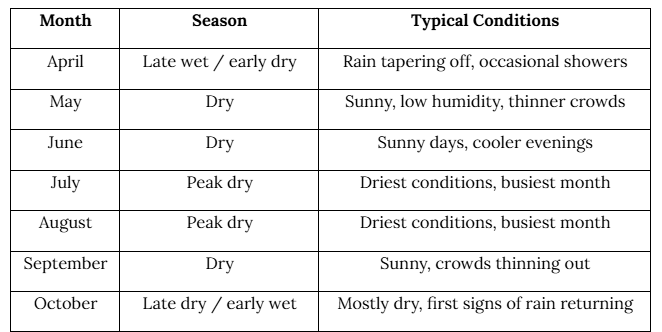
Bali weather guide showing dry season conditions from April to October, including the peak dry months of July and August.


May, June, and September are often the sweet spot: dry-season weather without the peak crowds and prices of July and August. From November to March, expect more rain, higher humidity, and a noticeably quieter island.

What is the best weather in Bali for enjoying a beautiful sunset and clear skies at the beach?


What Is the Best Month for Different Bali Experiences?

Since “best” weather means different things depending on your plans, here’s how it breaks down by activity.


Best Weather for Beach Holidays

For swimming, sunbathing, and water sports, the dry season, especially May through September, brings the calmest seas and cleanest beaches. Rougher surf and beach debris are more common during the wet season.

Best Weather for Hiking and Outdoor Activities

Trails on Mount Batur and other volcanic routes are safest in the dry season, when paths aren’t muddy and sunrise visibility is at its best. In the wet season, short rice-terrace walks are fine, but serious hikes become riskier.

Best Weather for Sightseeing and Cultural Trips

Temples, museums, and day trips work well in either season. The wet season can even suit sightseeing nicely, cooler air between showers, lusher scenery, and thinner crowds. Just build some flexibility into your schedule in case a downpour interrupts outdoor plans.

Best Weather for Travelers Who Want Fewer Crowds

Here’s the trade-off: the driest weather (July and August) also lines up with Bali’s busiest, priciest stretch. If you’d rather skip the crowds without giving up good weather, April, May, September, and October offer a solid middle ground.


See also: What to Do in Bali: A Simple Guide for Every Type of Traveler


Bali’s Dry Season vs. Wet Season, Compared

Dry Season (April–October)

Running roughly from April to October, Bali’s dry season brings lower humidity, more sunshine, and far less rainfall. Average temperatures sit at about 24–26°C, with July and August the coolest months, while daytime highs commonly reach the low 30s. It’s the most reliable window for beaches, hiking, and outdoor sightseeing. The trade-off is timing: July and August pair the best weather with the highest prices and biggest crowds.

Wet Season (November–March)

From November to March, Bali sees more rain and higher humidity. Average temperatures are similar, at roughly 25–26°C, so the difference is felt in the air’s stickiness more than the heat. Rain rarely falls all day, showers arrive in short, heavy bursts, often in the afternoon or evening, followed by clearer skies. This season still suits temples, spas, and lush rice terraces, usually with fewer visitors and lower prices.

Choosing the Right Weather for Your Bali Trip

If you want Bali’s most dependable weather, aim for the dry season between April and October, keeping in mind that July and August bring the biggest crowds along with the sunniest days. Prioritizing beaches or hiking points you toward May through September, prioritizing culture, budget, or quieter sights makes the wet season, or the shoulder months around it, a reasonable trade-off. Match the season to what you actually want to do in Bali, and the weather will take care of the rest.


Frequently Asked Questions

What month has the best weather in Bali?

June through September generally offers Bali’s most reliable weather, with July and August the driest. May and June are strong alternatives if you want dry-season conditions with smaller crowds.

Is Bali rainy all day during the wet season?

No. Wet-season rain typically arrives in short, intense bursts, often in the afternoon or evening, rather than continuous rain throughout the day.

Is August a good month to visit Bali?

Yes, weather-wise August is typically dry and sunny. Just expect it to be one of the busiest and most expensive months to visit.


Nusa Medica Sea Ambulance: Medical Evacuation Across Bali and Nearby Islands

Nusa Medica Sea Ambulance: Medical Evacuation Across Bali and Nearby Islands

When a medical emergency happens on an island, getting a patient to the right hospital can be a challenge. Road transport is not always an option, and in some locations, traveling by sea is the most practical way to reach a referral hospital. To support faster medical referrals between islands, Nusa Medica Clinic Group has introduced the Nusa Medica Sea Ambulance, a dedicated medical evacuation vessel designed for patient transfers by sea. The service is available for both local residents and international travelers who need further medical treatment at a referral hospital. According to its official E-Pas document, the vessel is registered for medical evacuation and ambulance purposes.

Why the Nusa Medica Sea Ambulance Matters

Dr. I Gde Yudha Kurniawan, Operational Director of PT Nusa Medica Assistama, explained that the main purpose of the service is to speed up referrals from island clinics and primary healthcare facilities to hospitals with more advanced medical facilities.

“The main purpose of the Sea Ambulance is to speed up the referral process for patients who need further treatment at a referral hospital. The service is available for both local residents and international travelers, while also supporting tourism through better access to medical services,” said Dr. Yudha.

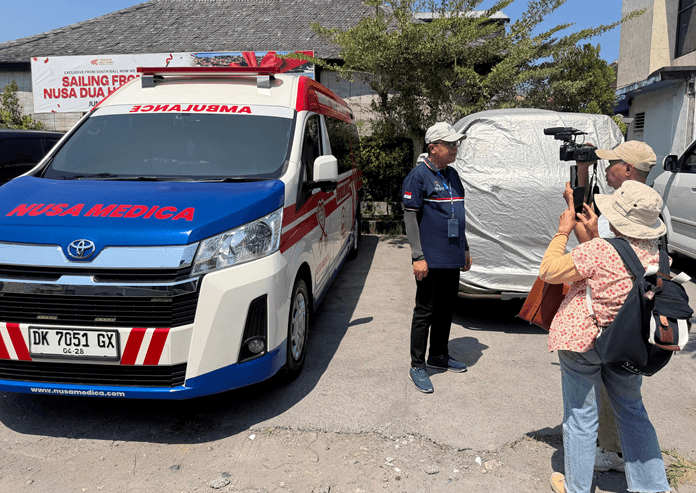
Operational Director PT Nusa Medica Assistama dr. I Gde Yudha Kurniawan during a media interview beside a Nusa Medica ambulance.

The service covers patient transfers from Nusa Lembongan and Nusa Penida, including routes to Sanur and Padang Bai. Depending on the patient’s medical and referral needs, the service can also reach Gili Air and Gili Trawangan.

For people living on or visiting these islands, having a dedicated water ambulance provides another option when a patient needs to reach a hospital on the mainland.

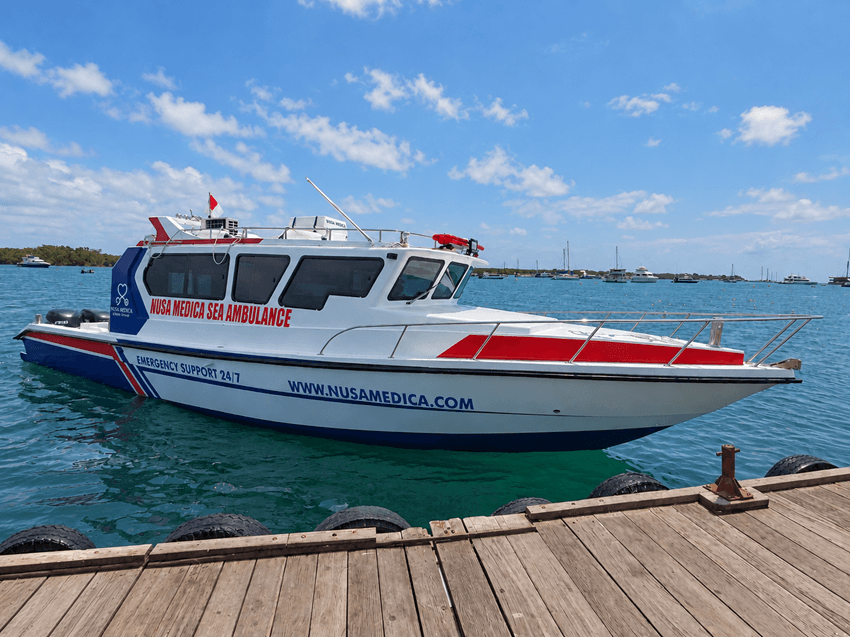
Nusa Medica Sea Ambulance for inter-island medical evacuation and emergency patient transport in Bali.

See Also: Visit a Doctor in Gili Trawangan: Your Ultimate Guide


Sea Ambulance Specifications

The sea ambulance specifications are designed to support inter-island medical transportation. According to its official E-Pas, the fiberglass vessel measures 11.10 meters in length, 2.70 meters in width, and 1.10 meters in depth.

Ridho Ananda, Call Center Manager of Nusa Medica Assistama, said the boat is powered by three Yamaha engines with a combined output of 750 PK.

Of course, an ambulance boat is not just about the boat itself. The ambulance boat inside is equipped to support patients while they are being transported. Medical equipment includes a ventilator, patient monitor, oxygen, and other supporting medical devices. Patients can also be accompanied by trained and certified medical personnel during the evacuation.

What Medical Cases May Need a Water Ambulance?

Not every medical problem requires evacuation by sea. A sea ambulance may be needed when a patient has been assessed or initially treated at a clinic but requires further care at a hospital.

According to Dr. Yudha, examples include head trauma, fractures, diarrhea with dehydration, heart conditions, and other cases that require further hospital treatment.

In addition to patient transfers from Nusa Penida, Nusa Lembongan, and the Lombok/Gili area, the vessel can also respond to emergency calls at sea within its operational area when assistance is requested by agencies such as BPBD or BASARNAS. This gives emergency responders an additional medical transport option when accidents or other emergencies happen at sea.

Supporting Medical Access Across the Islands

For island destinations, transportation is an important part of emergency medical care. A clinic may be able to provide initial treatment, but some patients still need to be transferred to a hospital with more advanced facilities.

The Nusa Medica Sea Ambulance helps bridge that gap by bringing together sea transportation, medical equipment, and trained medical personnel in one coordinated evacuation service.

This can be particularly useful in destinations where access to referral hospitals depends on crossing the sea, helping both local communities and travelers get the next level of medical care when they need it.(*)

Frequently Asked Questions

What is a water ambulance?
A water ambulance is a vessel used to transport patients by sea when they need medical evacuation or referral to another healthcare facility.

Which islands can the service reach?
The service covers Nusa Lembongan and Nusa Penida, with routes to Sanur and Padang Bai. It can also reach Gili Air and Gili Trawangan depending on the patient’s referral needs.

What equipment is available inside the ambulance boat?
Medical equipment includes a ventilator, patient monitor, oxygen, and other supporting medical devices.

What medical cases may require evacuation by sea?
Examples include head trauma, fractures, diarrhea with dehydration, heart conditions, and other cases that require further treatment at a hospital.

Can the boat respond to emergencies at sea?
Yes. Within its operational area, the vessel can also support emergency responses at sea when assistance is requested by agencies such as BPBD or BASARNAS.